Showing posts with label English for Uni. Show all posts

09 June, 2015

Time Management

Are you too busy to do your assignments? Or too worried about producing a perfect piece of work? Some of the English for Uni team have put together a video about time management. The video features 7 characters whom you might relate to:

Busy Bertie is a single father with six children under the age of 5. He works full time, plays the guitar in a rock band, has a part time job as a website designer and volunteers twice a week at a centre for homeless koalas.

Helpful Hattie can never say no, so she is extremely busy cooking meals for her friends, watering their plants, walking their dogs and doing their shopping. She also lets them copy her assignments. (A very bad move.)

Lazy Laura can't be bothered to work and would rather buy an essay off the internet. (Another very bad move!)

Party Patty just wants to have fun, but her parents want her to be a lawyer.

Perfect Pedro never submits his assignments on time because they are never good enough for his high standards (or the standards of his Dragon Mother).

Puzzled Paul doesn't know how to use a computer, so he cannot keep up with his coursework, but he doesn't want to ask for help.

Tired Tina is in the wrong time zone and cannot get to sleep. 

Do you identify with any of these characters? What advice would you give them?

You can see the full video here.


16 January, 2015

Video captions

Many earlier users of the website requested that we add captions to the videos. We now have English captions for all the videos on YouTube, and these captions can be turned on or off. Sometimes they obscure the captions already in the videos, but I'm afraid we can't do anything about that.

Adding the captions was an interesting and complicated process. YouTube does its own automatic captions, with often hilarious results:


Instead of "You cannot write English without us" the automatic text in the caption said "you kind of diet industry nationalist".

Another example was "by their first degree murder and" instead of "My name's Professor Grahamarian". Our website seems much more violent through YouTube instant captioning!


Capturing other languages and accents is even harder. Oscar Cicada's words "or, as it is known in Spanish, Tengo talento pero no mucho talento" became "a series now in Spanish being with a lentil I don't know much" and "that you must have talent to win" became "dot you must of Thailand doing".

Making changes to the instant captions can take several hours, as each set of words is divided like this:


     92
     00:06:16,970 --> 00:06:20,560
     result there is also the contest

     93
     00:06:20,560 --> 00:06:24,430
     indicate dot you must of Thailand doing

     94
     00:06:24,430 --> 00:06:29,870
     a habitual action in the present


That means we couldn't just paste in our own transcript and allow YouTube to use our words. We either had to add timings to our transcript or fit our transcript to the timings. To make it even harder, the timings for the smaller video chapters didn't match the timings for the whole video, so each chapter had to be done separately.

For the film editors, adding captions was just as problematic, as each bit of text had to be entered manually and couldn't be copied and pasted from another file.  That's why we didn't add built in captions to all our videos - it would have doubled the editing time! Built in captions are always there, too, so there is no flexibility to turn them off if you want to practise your English without any prompts.

We hope we've reached a happy compromise between built in and additional captions. If you have any suggestions, though, please add them in the comments box and if we make more videos we'll certainly bear them in mind! 


28 November, 2014

Feeling tense?

I'd always thought tenses were fairly easy to learn in English, because the other languages I'd studied were all western European and had tense systems that weren't too far removed from English. Then I started working with students whose first language was Indonesian or Chinese and I realised that not all languages work the same way as French, Spanish or German. In fact, they may not have changing verb endings at all. That makes English tenses really difficult for speakers of many other languages.

We introduce our English for Uni video 'You've Got Talent' with an opening scene in which an Indonesian student
is asking for help with English verb tenses because she is writing an essay about talent contests. By chance, both she and Ms Parrot had attended a talent contest the week before. We then have a flashback to the talent contest, followed by an explanation of the use of different tenses in English academic writing.

You'll notice that one tense I've used twice in the paragraphs above is the past perfect: I'd thought, I'd studied. This is a tense that's really hard to use and to explain. I would describe it as an action that happens before another action in the past. However, everything in the past happens before another action in the past!

That's where the idea of aspect is useful. Celce-Murcia and Larsen-Freeman, in The Grammar Book, divide the conventional twelve tenses in English into combinations of tense and aspect, and suggest four different aspects in English: simple, continuous/progressive, perfect and perfect continuous/progressive. That means we can have present, past and future simple (e.g. I work, I worked, I will work); present, past and future perfect (e.g. I have worked, I had worked, I will have worked); present, past and future continuous/progressive (e.g. I am working, I was working, I will be working); and present, past and future perfect continuous/progressive (e.g. I have been working, I had been working, I will have been working).

Aspect describes how we see an action, whereas tense relates to the time the action occurrs. The perfect aspect means that a verb using this aspect is connected to another point in time. e.g. I had thought tenses were easy . . . until I knew more about them. In this case, I am looking back from one point in the past to a point further back in the past.
 
We have put a bit more information on this on the English for Uni website in the section called 'Aspect - for advanced grammar lovers'.

If these ideas make you feel more tense, watching the You've Got Talent competition will help you to relax!

Reference:
Celce-Murcia, M & Larsen-Freeman, D 1999, The grammar book (2nd edn), Heinle Cengage Learning, Boston, MA.

12 November, 2014

New videos


We're finally there. The new videos are ready and we have uploaded all our new materials to the website. We've also made a DVD. Here is the cover, filmed in a carriage at the National Railway Museum in Port Adelaide. Our new materials cover conditionals, prepositions and tenses.


The conditionals materials are based on the Chinese dating show Fei Cheng Wu Rao, known in English as "If You Are the One". In our version, we have one male contestant and three lovely ladies. The script uses all the different types of conditional forms in English and includes other types of conditional words, such as 'otherwise' and 'provided that'.


The materials for tenses in academic writing are based around a student writing an essay about talent contests. She has trouble with her verb tenses and consults Ms Parrot for help. Funnily enough, she and Ms Parrot had both been to a talent contest the week before.


Ms Parrot played in the Really Really Terrible Quartet (so terrible that there were only three players). 


After the quartet's dreadful performance it was no surprise that the show was won by Prince Wolfgang and the Medics.


The last of our new resources is based on the difficult area of prepositions. All the materials are based on words from Averil Coxhead's Academic Word List. The video story this time is a murder mystery. Watch it and find out what happens to the famous chef Harumi Kaga.


We hope you'll enjoy using the new resources. Whatever you think, please complete the short evaluation survey on the website to give us some feedback, as we really want to keep improving the site. You might even a $100 voucher for taking part in the survey!

31 October, 2014

The English for Uni Roadshow

What is a good way to publicise something? One answer is: via a roadshow. A roadshow is a travelling event to publicise and showcase a resource to a large number of people in different places. The idea of a roadshow is to give people a taste of what's on offer so they want to learn more about it. Publishers, for example, may have roadshows to promote a group of their authors to potential readers. 

At a project managers' meeting a few months ago someone suggested that we have an English for Uni roadshow. That sounded good. However, a real live roadshow would mean taking the English for Uni project team and actors round Australia, and that was something we hadn't budgeted for. Then another suggestion was made: why not have a 'virtual roadshow'? What a great idea!

From that suggestion, we went on to film a virtual roadshow which promotes all the resources on our website and also introduces you to nearly all the team members, as well as many of the principal actors in the videos. We are pleased to announce that the English for Uni virtual roadshow is now live on the front page of the website. You can also see it on YouTube.

Creating the content was interesting. Originally we wanted to put a transcription of each person's words into the video, so you could read their words and listen to them at the same time. That made screen too cluttered, so we opted for a reminder of the English for Uni website address instead, and a key word in the top right hand corner. 

For Harumi Kaga,

for instance, you can see the word 'Japanese' in the corner,

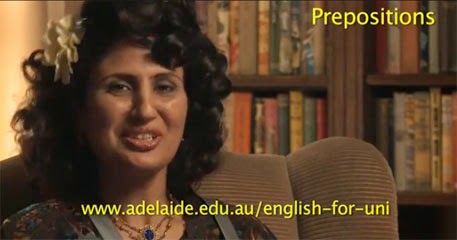
while for Kareena Kapadia
there is the word 'prepositions'.


We hope that the English for Uni roadshow will be played on screens and monitors in educational establishements all round Australia, and even in other countries. If you would like a copy for your school, college or university, please contact us via the website!


24 October, 2014

The Ms Parrot DVD

I had no idea it was so difficult to 'author' a DVD! This technical process involves putting all our current videos onto a single DVD. The software to do this, though, is extremely expensive, and the whole process is very costly. That's why we've opted for a slightly lower resolution version that will allow all our videos to fit on one DVD. The result will be something like this:
Don't worry - the spelling mistake will be corrected! In fact 'Saving English Grammar' will also be renamed to 'Thanks a Million'.

What is really nice about this DVD is that the film maker has made a clever compilation of extracts from all six stories and put them in an opening screen that plays with the Ms Parrot theme. Viewers can then click on any of the titles below to play that particular video.

All these videos will be freely available online, and we will also upload them to Youku so our Chinese viewers can enjoy them. We're really hoping that our take on Fei Cheng Wu Rao will be big in China!


02 October, 2014

Interview with David Crystal

Ms Parrot and Harumi Kaga were lucky enough to talk to the famous linguist Professor David Crystal about the importance of grammar when they were all at the GAL 2014 Congress in Marburg. You can see the interview on the English for Uni website.

18 August, 2014

Welcome to the English for Uni blog


This is the new blog for the English for Uni website.

Have a look at the resources on the webpage and use this page to ask questions for other readers to answer. I can't promise to answer all questions personally, but I hope we can start a community where we can comment on each other's questions.

You'll find materials on the English for Uni website to help you with different areas of English writing and academic literacy skills, such as essay writing:


        the passive voice


articles (a/an/the)


and oral presentation skills. 


You can watch humorous videos, view the explanations of difficult points of English grammar and academic skills, and try the exercises.

See you there!

Ms A Parrot
(Julia Miller: julia.miller@adelaide.edu.au)


(www.adelaide.edu.au/english-for-uni)